The Physics Behind the Climate Crisis:
Equations That Explain a Warming Planet
Climate change is not just an environmental issue — it is a physics problem. Every headline about rising temperatures, melting ice caps, and extreme weather events has a precise physical mechanism behind it. Understanding those mechanisms transforms abstract concern into actionable knowledge.
Environmental science and physics are inseparable. The greenhouse effect, ocean heat capacity, albedo feedback loops, and atmospheric radiative transfer are all governed by the same laws that describe a pendulum or a circuit. This article walks through the core physics equations that underpin the climate system — the kind of problems that, until recently, required a graduate-level textbook to approach.
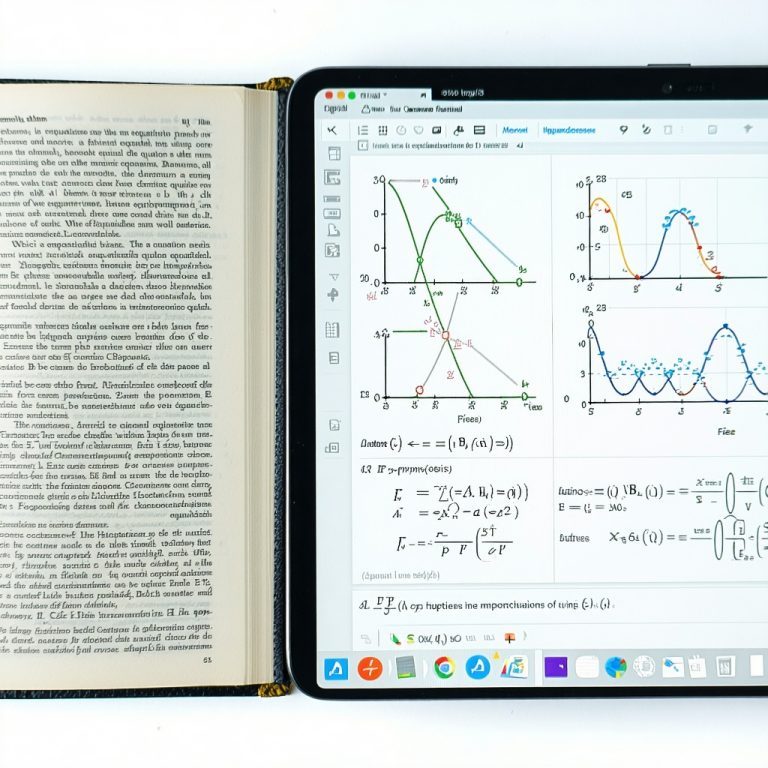
Each equation here can be solved, explored, and visualised using a specialised physics solver. That’s not just a convenience — it’s how researchers, students, and engineers actually build intuition about complex systems.
1. The Greenhouse Effect: Radiative Forcing
The atmosphere acts as a partial insulator for Earth’s surface. Incoming solar radiation passes through relatively easily, but outgoing infrared radiation is partially absorbed by greenhouse gases — CO₂, methane, water vapour — and re-emitted in all directions, including back toward the surface.
The fundamental quantity is radiative forcing — the change in energy flux at the top of the atmosphere caused by a perturbation like increased CO₂:
Where: ΔF = radiative forcing (W/m²), α ≈ 5.35 for CO₂, C = current CO₂ concentration, C₀ = pre-industrial baseline (~280 ppm)
At current CO₂ levels (~425 ppm as of 2026), this gives approximately +2.1 W/m² of forcing from CO₂ alone — meaning every square metre of Earth’s surface receives 2.1 watts more energy than it did before industrialisation. That doesn’t sound like much until you multiply it by Earth’s surface area: 5.1 × 10¹⁴ m².
Total additional energy absorbed per second:
That’s roughly 1 petawatt of excess energy — equivalent to detonating 17 Hiroshima-sized bombs every second, continuously, across the entire planet’s surface.
2. Stefan-Boltzmann Law and Earth’s Energy Balance
A planet in thermal equilibrium emits as much energy as it absorbs. The Stefan-Boltzmann Law governs how much radiation a body emits based on its temperature:
Where: ε = emissivity (≈0.612 for Earth with atmosphere), σ = 5.67×10⁻⁸ W/m²K⁴, A = surface area, T = temperature in Kelvin
Earth’s equilibrium temperature without any atmosphere would be approximately −18°C. The actual average surface temperature is around +15°C. That 33°C difference is the natural greenhouse effect — the atmosphere acts as a thermal blanket, raising the equilibrium temperature to one compatible with liquid water and life.
The problem is that the blanket is thickening. As greenhouse gas concentrations rise, the effective emissivity decreases, and the equilibrium temperature must rise to restore energy balance. A 1°C increase in global average temperature requires only a tiny shift in this equilibrium — but represents an enormous change in the total thermal energy stored in the climate system.
Pre-industrial equilibrium
CO₂ ≈ 280 ppm
ΔF = 0 (baseline)
T_avg ≈ 13.8°C
2026 equilibrium (committed)
CO₂ ≈ 425 ppm
ΔF ≈ +2.1 W/m²
T_avg ≈ 15.1°C (+1.3°C above baseline)
3. Ocean Heat Capacity and Thermal Lag
One reason the climate system responds slowly to forcing is the enormous heat capacity of the oceans. The specific heat equation for energy storage is:
Where: Q = heat energy (J), m = mass of ocean water, c = specific heat of seawater ≈ 3,850 J/kg·K, ΔT = temperature change
The world’s oceans contain approximately 1.335 × 10²¹ kg of water. Raising the average ocean temperature by just 0.1°C requires:
This is why the oceans act as a massive thermal buffer — absorbing over 90% of the excess heat from radiative forcing and delaying the full surface temperature response by decades. It also means that even if all greenhouse gas emissions stopped today, temperatures would continue rising for 20–40 years as the oceans slowly equilibrate with the atmosphere.
4. Ice-Albedo Feedback: A Self-Amplifying Loop
Albedo (α) is the fraction of incoming solar radiation reflected by a surface. Fresh snow has α ≈ 0.85 (reflects 85% of light); open ocean has α ≈ 0.06 (absorbs 94%). When ice melts and exposes darker ocean or land, the surface absorbs more energy — which causes more warming, which causes more melting. This is a positive feedback loop.
The absorbed solar power at a surface is:
Where: S = solar irradiance ≈ 1361 W/m², A = surface area, α = albedo of surface
Arctic Sea Ice: A Case Study in Feedback
Arctic sea ice extent has declined by roughly 13% per decade since 1979. As ice is replaced by open ocean, the albedo of that region drops from ~0.60 to ~0.06 — a change of 0.54. For a patch of Arctic ocean 1 km² in size:
Every square kilometre of ice lost to open ocean adds the equivalent of 735 megawatts of continuous heating during the sunlit season — with no additional CO₂ required.
5. Sea Level Rise: Thermal Expansion and Ice Melt
Sea level rises through two primary mechanisms: thermal expansion of warming water, and mass addition from melting ice sheets and glaciers.
Thermal Expansion
Water expands as it warms. The volumetric thermal expansion of seawater is governed by:
Where: β = volumetric thermal expansion coefficient of seawater ≈ 2.6×10⁻⁴ K⁻¹, V₀ = initial volume of ocean ≈ 1.335×10¹⁸ m³
A 1°C rise in average ocean temperature produces approximately 0.5 mm/year of sea level rise from thermal expansion alone — accounting for roughly one-third of current observed rise.
Ice Sheet Contribution
The Greenland ice sheet contains approximately 2.85 million km³ of ice. Complete melting would raise global sea levels by about 7 metres. The mass balance equation:
Current observations show Greenland losing approximately 280 billion tonnes of ice per year — contributing roughly 0.8 mm/year to global sea level rise and accelerating.
Environmental Physics in Practice: Why Solvers Matter
Each equation above represents a system that can be modelled, parameterised, and explored quantitatively. Students and researchers working on environmental problems — whether calculating the energy balance of a proposed carbon capture system, modelling coastal flooding under different warming scenarios, or studying atmospheric radiative transfer — need tools that handle the mathematics correctly.
The equations governing climate are the same equations that govern heat transfer, fluid dynamics, and electromagnetism in any other physics context. A thermal expansion problem in a climate model uses identical mathematics to a thermal expansion problem in materials science. A feedback loop analysis in atmospheric physics uses the same differential equation framework as a circuit analysis.
Typical Environmental Physics Problems
| Problem type | Physics domain | Key equation |
|---|---|---|
| Greenhouse gas forcing | Radiative transfer | ΔF = α·ln(C/C₀) |
| Ocean heat uptake | Thermodynamics | Q = mcΔT |
| Albedo feedback | Optics / Energy balance | P = (1−α)·S·A |
| Thermal sea level rise | Fluid mechanics | ΔV = βV₀ΔT |
| Wind turbine power output | Fluid dynamics | P = ½ρAv³·Cp |
| Solar panel efficiency | Quantum / Thermodynamics | η = P_out / (S·A) |
Understanding the physics doesn’t require accepting any particular policy position — it requires engaging honestly with the mathematics. The numbers don’t care about politics. A petawatt of excess absorbed energy is a petawatt of excess absorbed energy regardless of who calculates it.
The Climate System Is a Physics Problem — Treat It Like One
Every metric in the climate debate has a physical basis that can be quantified, checked, and understood. Radiative forcing, thermal expansion, albedo feedback, ice mass balance — these are not abstract concepts. They are equations with inputs and outputs that any physics student can work through.
The tools to do that work are better than they have ever been. Whether you’re a student studying environmental physics, an engineer designing renewable energy systems, or a researcher modelling atmospheric dynamics, a specialised physics solver handles the mathematical heavy lifting — so you can focus on understanding what the numbers mean.
Solve Environmental Physics Problems Instantly
From radiative forcing to thermal expansion — step-by-step solutions with the Axiom-1 Logic Engine.

Rachel Okonkwo is an applied physics researcher and AI STEM tools reviewer with 6 years of experience across academic research and science education. She holds a B.S. in Physics from MIT and specializes in evaluating AI physics solvers for accuracy, formula correctness, and real student usability.